


Blog/
Blog/
As databases become critical infrastructure supporting core business operations, enterprises are increasingly concerned not only with whether data can be securely stored, but also with whether business operations can be restored promptly when production clusters become unavailable. How to protect data, minimize business downtime, and establish an executable recovery process has become an essential challenge in database reliability.
Backup is the foundation of this system, but having backups does not necessarily mean having disaster recovery capabilities. While backups provide the foundation for data preservation and restoration, Disaster Recovery (DR) focuses on a further question: when the production cluster becomes unavailable, can the disaster recovery cluster take over and restore business operations while ensuring data consistency and a controlled recovery process? For MPP distributed databases, this challenge is even more complex. In addition to ensuring data integrity, the master node and individual data segments must be restored to mutually consistent states, with corresponding adjustments to cluster roles and topology. Only when these operations are coordinated can the disaster recovery cluster take over business workloads as a unified system.
YMatrix DR is designed to address precisely this challenge. Through cluster-level physical replication, it enables the disaster recovery cluster to continuously receive data changes from the production cluster. When a takeover is required, global recovery points coordinate recovery across all segments to a consistent state, followed by cluster role transitions that enable the disaster recovery cluster to independently provide read and write services.
Backups provide the foundation for data recovery. Depending on the backup method and the readiness of the environment, restoring services may involve machine preparation, software deployment, data restoration, log replay, cluster validation, and application connection adjustments. The time required for each of these steps must be included in the recovery plan.
For core business operations, a recovery solution must also answer another fundamental question: how long can the business tolerate an interruption? Whether backups have been completed successfully, whether data can be restored, and whether the overall recovery process can meet the Recovery Time Objective (RTO) are all aspects of database reliability that must be verified.
In an MPP distributed database, recovery also requires coordination across multiple nodes. Data restoration and log replay must cover all data segments. The states of the master node and segments must be validated, and applications must reconnect to the database. Data volume, log replay volume, available resources, and operational procedures all affect the actual recovery time. If these operations are performed only after a failure occurs, recovery time and operational uncertainty can increase significantly.
While the production system is operating normally, YMatrix DR continuously maintains a disaster recovery cluster that is ready for takeover. Through cluster-level physical replication, it establishes a continuously synchronized disaster recovery environment for the master node and all data segments.
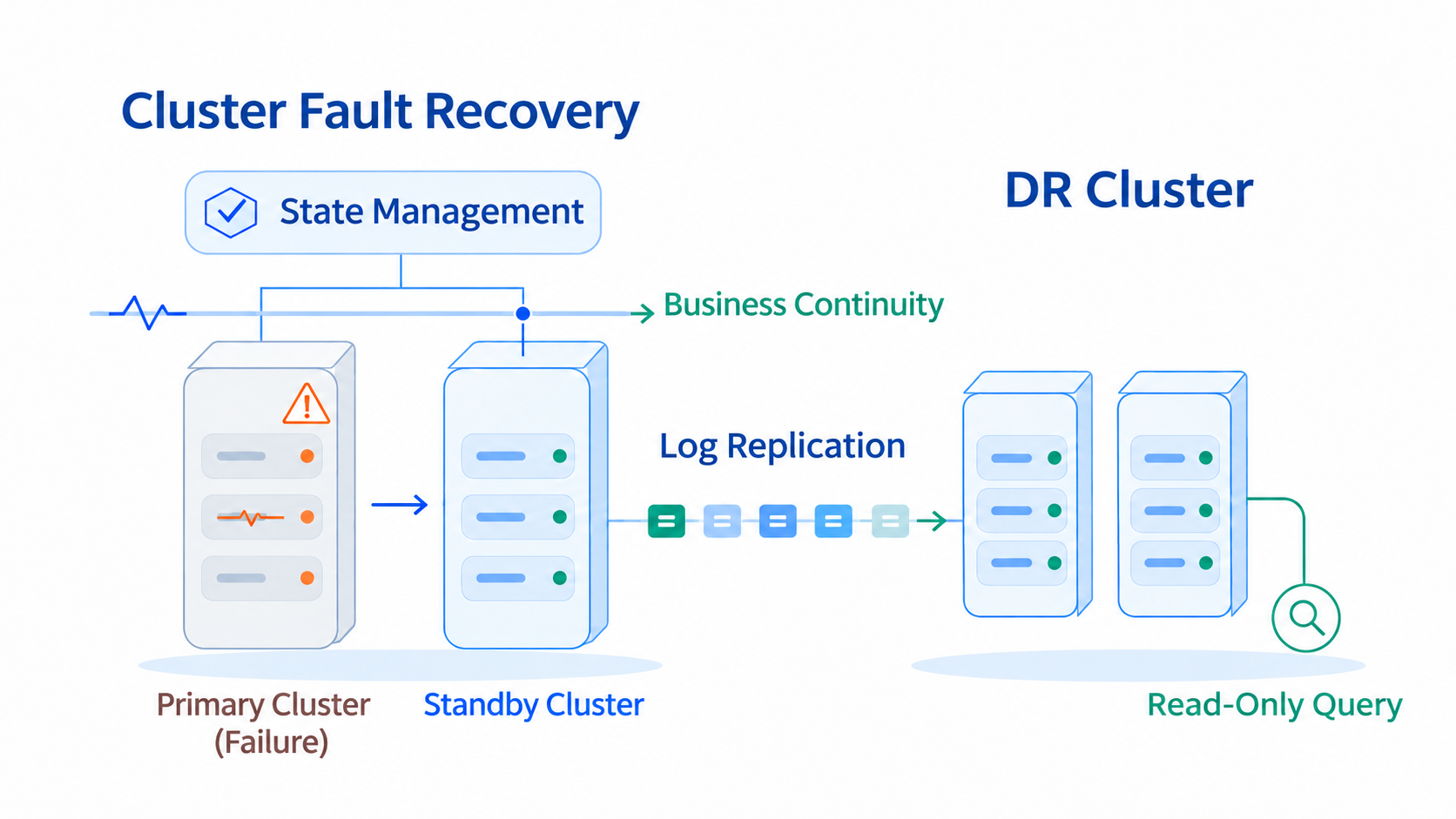
The primary cluster handles routine read and write operations, while the disaster recovery cluster can be deployed in another data center to continuously receive data changes from the production environment. The disaster recovery cluster also supports read-only queries. When a takeover becomes necessary, the operations team can initiate recovery using the existing disaster recovery cluster, reducing the need to provision a new environment or perform a full data restoration. This provides a foundation for minimizing business downtime and meeting RTO requirements.
In an MPP database, a single transaction may modify data across multiple segments, while the progress of log replay may vary among nodes in the disaster recovery cluster. If only some segments contain the changes made by a transaction after recovery, the resulting business data may be inconsistent. Therefore, cluster recovery must coordinate transaction states across the master node and all segments, rather than relying solely on the recovery progress of an individual node.
YMatrix DR addresses this requirement through global recovery points. The primary cluster periodically creates global recovery points that record the corresponding Write-Ahead Log (WAL) positions of the master node and each data segment. These positions are associated with a common consistent recovery boundary. The disaster recovery cluster uses this information to coordinate log replay across its nodes. During takeover, each node is restored to the consistent state defined by this boundary before the cluster role transition is completed.

Although the disaster recovery cluster supports read-only connections, individual segments may be at different stages of log replay. As a result, cross-segment consistency of query results cannot be guaranteed at arbitrary points in time. This limitation must be considered when planning query workloads on the disaster recovery cluster.
A disaster recovery strategy must define a Recovery Point Objective (RPO), which specifies the amount of data loss that a business can tolerate, and select the replication mode accordingly. YMatrix DR supports two replication modes. With asynchronous replication, production transactions do not need to wait for confirmation from the remote replication destination, making this approach more tolerant of latency between data centers. However, replication lag may increase potential data loss in the event of a failure. With synchronous replication, transactions must wait for remote confirmation, which helps strengthen data protection but may also cause transaction commits to be affected by remote latency and network conditions. Enterprises can flexibly select and adjust replication modes based on their requirements for data protection and transaction response times, as well as network conditions between data centers.
When a disaster prevents the production cluster from continuing to provide services and the disaster recovery cluster must take over, administrators should first assess the scope of the failure and verify the status of the disaster recovery environment. They must also ensure that the original production cluster can no longer accept write operations, preventing both clusters from processing write workloads simultaneously. Once the takeover conditions have been confirmed, administrators can execute mxdr switch on the master node of the disaster recovery cluster. The tool automatically promotes the master node and all data segments to their new roles and updates the local cluster topology. After the operation is completed, the disaster recovery cluster is formally converted into an independent YMatrix cluster capable of providing both read and write services.
YMatrix DR continuously maintains a disaster recovery replica through cluster-level physical replication and uses global recovery points to ensure consistent recovery across data segments. When the production cluster becomes completely unavailable, enterprises can use the existing disaster recovery cluster to perform consistent recovery and database takeover, reducing the need for environment reconstruction and full data restoration and helping shorten business recovery time.
By supporting both synchronous and asynchronous replication, YMatrix DR accommodates different data protection objectives, production performance requirements, and cross-data-center network conditions. It helps enterprises build a flexible and reliable disaster recovery architecture, providing a solid foundation for the continuity of mission-critical business operations.
How YMatrix Powers SVOLT’s Smart Factory Transformation
The PostgreSQL Streaming Model
In-depth Analysis (Part 2) — In the AI Era, Databases Are Entering the “Unified Storage Era”
From Greenplum to YMatrix: Migrating Core Business Data for a Leading Power-Battery Manufacturer
China Telecom Completes SAP HANA Localization Upgrade
Xiaomi and YMatrix Tackle the Big Data Challenge in 3C Smart Manufacturing