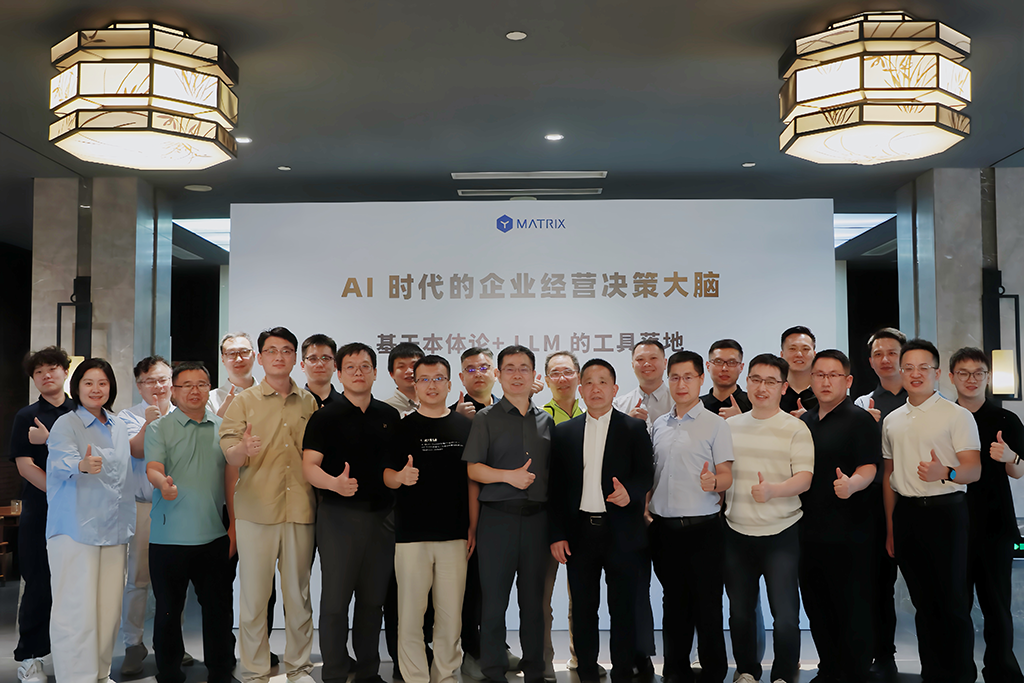
Recently, the technical salon titled “Enterprise Decision-Making Brain in the AI Era — Ontology + LLM-Based Practical Applications” was successfully held in Beijing. The event was hosted by YMatrix (Four-Dimensional Convergence), bringing together experts, enterprise decision-makers, and technical practitioners from multiple domains, including databases, enterprise digital intelligence, smart manufacturing, power systems, and data applications. The salon focused on the practical challenges, technical architectures, and industry applications of AI in enterprise operations. Participants engaged in in-depth discussions on building an intelligent enterprise decision-making system powered by ontology and large language models (LLMs), jointly exploring feasible pathways to implementation.
At the beginning of the event, YMatrix Founder and CEO Yao Yandong delivered the opening remarks. He noted that large models and agent technologies are reshaping business paradigms, yet enterprises still face significant practical barriers in AI adoption. This salon was designed as a platform for exchange, bringing together industry insights to explore an integrated “ontology + LLM” solution that bridges data and decision-making loops and helps close the gap between technology and real-world deployment.
In his keynote speech, Yao emphasized that the three core pillars of enterprise AI adoption are visible value, usable data, and ready tools. He pointed out that the main bottleneck in AI implementation is not model capability, but the complexity of aligning business and technology.
To truly leverage AI, enterprises must first externalize implicit business knowledge. By leveraging ontology and state-machine-like mechanisms, they can build an enterprise “world model” that spans the fact layer, ontology layer, decision layer, and action layer—forming a complete system architecture.
He also drew inspiration from decades of database evolution, highlighting the need to upgrade from data logic to semantic logic, enabling AI to become the true “brain” of enterprise decision-making. During the session, Yao also demonstrated a product prototype, showcasing the practical outcomes of ontology + LLM-based tooling and giving attendees a tangible sense of its capabilities.
Luo Xiaojiao, Vice President of Yonyou Network Technology Co., Ltd. and General Manager of the Digital Intelligence Platform Solution Business Unit, delivered a keynote titled “Harnessing AI to Reshape the Enterprise.”
Based on his experience in enterprise digital transformation, Luo explained how enterprise software is evolving in form and value during the AI era.
He proposed that enterprise AI adoption typically progresses through four stages: foundation building, connectivity, resonance, and restructuring. A unified digital intelligence platform is required to break down data silos and application barriers.
Yonyou’s BIP (Business Innovation Platform) is built on an architecture where AI, data, and business processes are natively integrated. By incorporating enterprise ontology, skill libraries, intelligent agents, and enterprise service LLMs, it enables enterprises to transition from traditional data intelligence to advanced decision intelligence, addressing the long-standing “decision black box” problem.
He also highlighted products such as YonClaw and YonCode, which together build a secure, trustworthy, and practical AI execution and development ecosystem.
In addition, he noted that Yonyou BIP is deeply compatible with YMatrix’s hyper-converged AI database, using it as a core data engine. Its native time-series and vector capabilities provide high-performance data support for LLMs and agents, enabling more efficient and stable AI application deployment.
Focusing on the infrastructure needs of the Agent era, Wang Jian, Solution Director at YMatrix, provided an in-depth interpretation of the new paradigm for data systems in the AI agent era. He reviewed the evolution of data systems from file storage systems to traditional databases and now to intelligent agent-driven architectures. He introduced a new data standard for AI agents: T.R.U.S.T — Traceable, Reliable, Understandable, Secure, and Testable—addressing traditional database limitations in semantic understanding, reasoning traceability, and trust evaluation.
As a hyper-converged data infrastructure designed for the Agent era, YMatrix integrates native capabilities such as time-series, vector, graph, and full-text search. With key technologies including row-column hybrid storage, vectorized execution, and unified streaming/batch processing, it achieves ultra-high throughput ingestion, millisecond-level complex queries, and extreme storage compression.
It also features an intelligent operations system that forms an automated closed loop of diagnosis → reproduction → repair → knowledge accumulation, providing stable, trustworthy, and high-performance data support for LLMs and intelligent agents.
Liang Yaoting, Manufacturing Intelligence Director at Xiaomi Corporation, shared the development of the Pengpai Intelligent Manufacturing Platform.
Addressing industry challenges such as data silos in manufacturing, weak generalization of industrial models, and hallucination risks in large models, Xiaomi built a next-generation AI Native Manufacturing OS based on YMatrix’s time-series processing, data analytics, and graph capabilities. The system consists of four layers:
After deployment in factories producing smartphones and home appliances, the platform significantly improved production efficiency, equipment utilization, and quality control, setting a benchmark for industrial AI applications.
Xiao Shaocong, a senior data expert in the power industry, shared practical applications of time-series analytics integration based on real-world grid deployment scenarios.
He noted that databases in the power sector have evolved from simple data storage to active participation in operational decision-making. In alignment with the OCS 2.0 standard, YMatrix successfully passed rigorous tests covering high-concurrency writes, large-scale data reads, sectional computations, and high compression ratios.
Leveraging its MatrixGate high-speed ingestion engine, Domino in-database stream processing, and Mars3 storage engine, the system enables real-time processing of grid time-series data, anomaly prediction, and root cause analysis—fully meeting the dynamic and real-time demands of modern power systems driven by renewable energy.
Liang Xiaofeng, Manufacturing Marketing Director at Fanruan Software Co., Ltd., focused on building a high-performance and high-quality enterprise data foundation.
He emphasized that AI competition is fundamentally competition in data infrastructure. Many enterprises still face inconsistent data standards, insufficient real-time capabilities, and weak data serviceability.
Fanruan, in collaboration with YMatrix, has built an integrated solution that connects the full pipeline of data acquisition, governance, analytics, and visualization. By combining a high-performance data foundation with an intelligent data application platform, enterprises can unlock data value, lower the barrier to data usage, and strengthen long-term digital competitiveness.
After all thematic sessions concluded, attendees engaged in further discussions on key challenges in enterprise AI adoption, focusing on ontology modeling methods, agent application practices, data governance frameworks, and industry adaptation pathways.
The salon not only clearly outlined the implementation logic of “ontology + LLM” but also demonstrated YMatrix’s forward-looking industry vision and strong technological capabilities. As a data infrastructure platform for the AI Agent era, YMatrix will continue advancing hyper-converged AI database technologies. Together with ecosystem partners, it aims to empower industries such as manufacturing, energy, and enterprise services—enabling end-to-end connectivity across data, knowledge, decision-making, and execution, and truly transforming AI from a technological concept into a core driver of business growth and industrial upgrading.


